
 Matt Dunn
Top 5 Shooting Myths in Lacrosse
 Deemer Class : Jan 15, 2021, 12:00:00 AM
These are the top 5 myths in teaching shooting in lacrosse.
.gif)
As coaches we’re always looking for the most impactful concepts to deliver to our players. Not always more information, but better information.
Whether it’s a team we’re coaching, a group we’re training, or a player we’re advising, the goal is the same. We aim to deliver information that drives desirable results.
There’s been a lot of discussion around CLA and principles over the last few years in sports. While much of it is well-intentioned and interesting, it often stays abstract.
The concepts around shot selection in here will be tangible.
I first came across this framework in Alex Sarama’s Transforming Basketball book. Sarama speaks to this framework at length, and it translates directly to lacrosse.
Shameless plug: if you like this type of content, you should really subscribe to our free coaches corner newsletter here.
In basketball, Sarama describes these as the following:
The goal is to get a gold medal shot every time, but that is not always feasible.
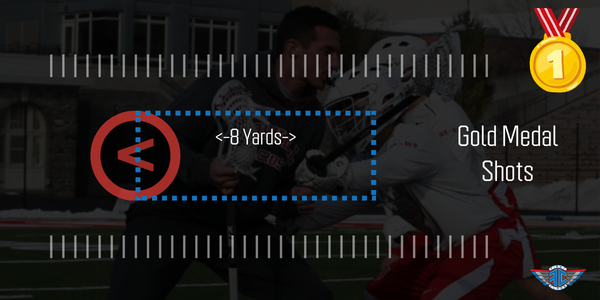
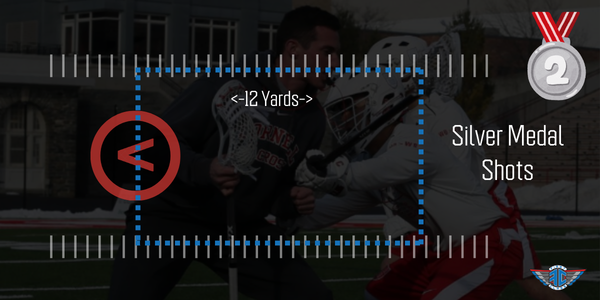
Gold Medal Shots in Lacrosse
We can apply the same lens to lacrosse. Jamie Munro gave a presentation at the IMLCA convention this past December on CLA drills and discussed this topic for lacrosse.
Rather than regurgitate his work, coaches can use the framework to create their own structure. It could be something like:
This piece is less about debating the perfect definition of a gold medal shot and more about developing a clear framework for your group.
You can alter minor nuances in your definitions. The point is simple: clearly label great shots.
III/ Why This Matters
Shot selection is arguably the most important concept in lacrosse.
You can have technically great shooters, but if shot selection is poor, that technique is wasted. On the flip side, defenses can start to build principles around denying gold medal shots when it's well-defined.
Too often, we label shots as “good” or “bad” as if those categories are obvious. Some players get a feel for it over time, but many can’t clearly define what makes a shot good or bad.
Calling something a gold medal shot and defining it removes the ambiguity. Players know exactly what you’re looking for.
.gif?width=739&height=415&name=Good%20Offense%20Mens%202-high%20(1).gif)
IV/ WHY THE MEDAL FRAMEWORK WORKS
There is a psychological concept known as the picture superiority effect (PSE). As the name suggests, images stick better than words.
Visuals encode both detail and meaning, which makes them easier to recognize and recall than abstract labels. In other words, the brain prefers pictures over lectures.
Both "high quality shot" and "gold medal shot" need to be defined. Neither term is self-evident without context. The difference is that the gold medal metaphor creates a stronger anchor once it is defined.
That image can sit in an 8-year-old's brain just as easily as an 18-year-old's. Players will be more likely to visualize and practice “gold medal shots” on their own than “high quality shots”.
It’s also just good branding. Kind of like how Red Bull “gives you wings”. That’s a bit more memorable than Red Bull “gives you energy”. It’s the same idea.
The clearer and more visual our language is, the better players hold onto it.
V/ Implementing gold medal Shots
Deemer and I recently ran a camp in Dallas and made gold medal shots the central theme of the entire two days.
One of our biggest pet peeves with camps is trying to do too much. Kids leave with a vague understanding of a lot of concepts instead of a clear understanding of a few.
We wanted them to walk away understanding this one thing very clearly: what gold medal shots are and why they matter.
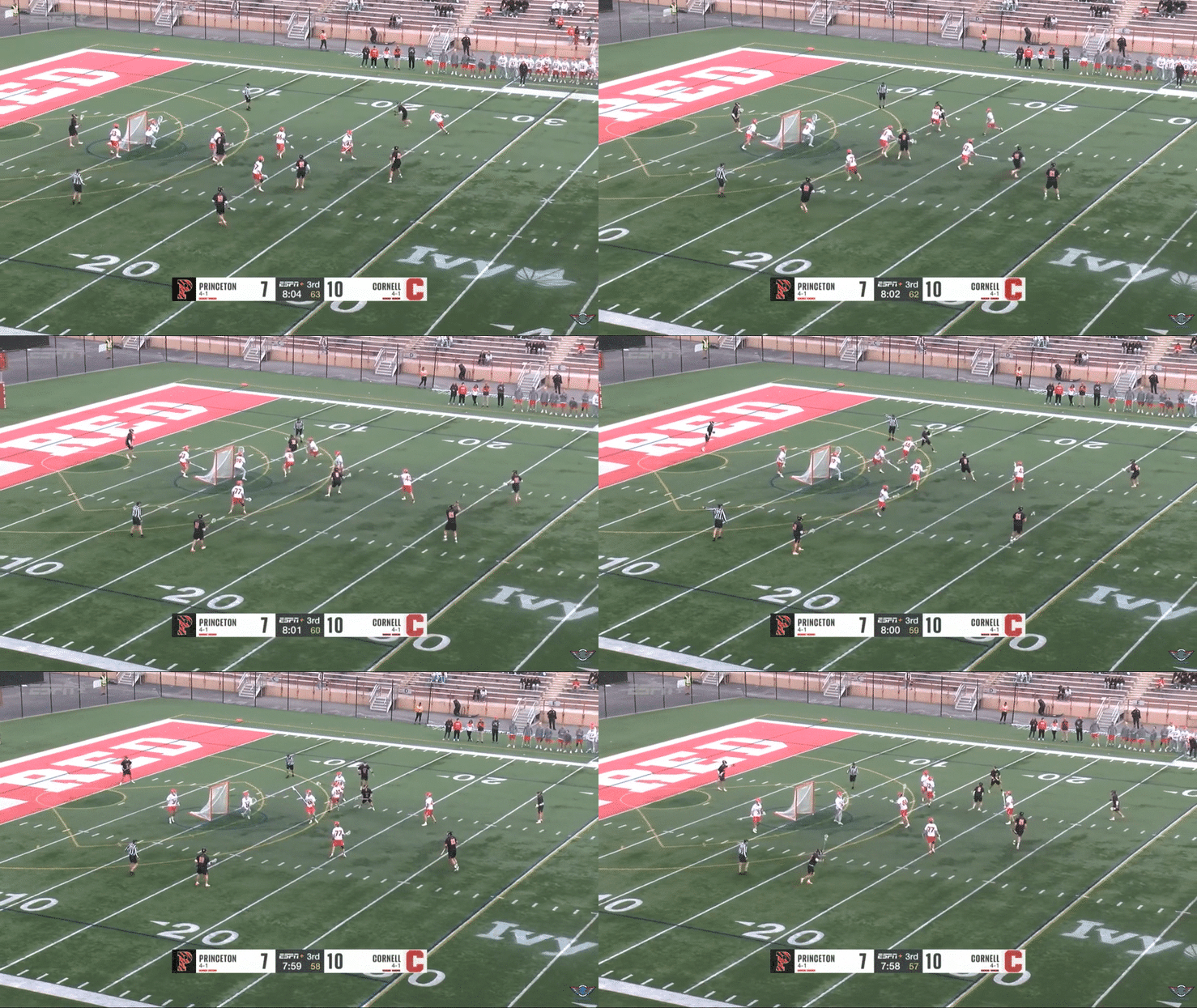
In most of the drills, we marked territory for gold medal shots. We used markers to zone out the width of the crease tangents and 8 yards up from GLE. The goal was simple: get shots from that area of the field.
You can even extend the framework. Silver medal shots. Bronze medal shots. No-medal shots.
This is a simple and fun framework of getting both our offense and defense to understand shot quality.
VI/ THE BENEFITS -- GET BETTER WHILE HAVING FUN
The best part of this framework is that it takes one of the most important parts of the sport and makes it fun for players.
You can apply it to almost any drill. This is what CLA is actually about: the shots become the constraint.
You could run a 4v3 where only gold and silver medal shots count. You can go back through film and tally gold, silver, and bronze shots for your players.
It creates shared language and gives you a simple way to gamify a critical concept. We all know how much players (and coaches) respond to games.
One of our core beliefs is that getting better can, and often should, be fun. Not everything is easy or enjoyable, but competing is the best part of sports. This framework adds clarity and context without overcomplicating things.
Check out our community and become a member to view drills, webinars, film breakdowns, courses and more. Use code BLOG15 for an exclusive discount to our membership community on Circle!
Deemer Class : Jan 15, 2021, 12:00:00 AM
These are the top 5 myths in teaching shooting in lacrosse.
Deemer Class : Nov 24, 2023, 11:45:00 AM
Discover the common shooting adjustments and self-corrections in lacrosse, and why less is more when it comes to analyzing shooting techniques.
Deemer Class : Apr 7, 2023, 11:00:00 AM
The Hitch is something that every offensive player needs in his or her bag. Period.